

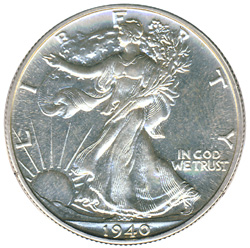
After a twenty year gap in production, the United State Mint resumed the production of Proof coins for collectors in 1936. Most consider this to be the beginning of the modern Proof coin era. Proof coinage was struck from 1936 to 1942 until another gap in production until 1950.
Proof coins issued during this era were sold by the U.S. Mint either individually or as a complete set. The coins could be purchased in person at the U.S. Mint or through the mail. Because of individual sales, the mintage for each Proof coin varies. For most years, the mintage for the one cent coin was the highest, and the mintage for the quarter dollar was lowest. Notable exceptions occur in 1938 when the five cent denomination was redesigned and in 1942 when it was struck in a different composition.
The overall mintages for each Proof Set, determined based on the lowest mintage individual coin, were very low during this time period. For the 1936 Proof Set, less than 4,000 complete sets can ever be assembled. Even the higher mintage 1942 Proof Set has a mintage of 21,120, which is extremely low compared to later production levels in the millions.
Because of individual sales, packaging for Proof coins of this era could vary. In general, coins were placed within individual cellophane sleeves. All coins from the customer order were then stapled at the top and placed within a box or envelope to accommodate the order size. Original packaging from this era is not commonly encountered as most of the coins reside in privately produced holders or third party grading holders to better preserve the coins.
1936-1942 Proof Sets by Year
- 1936 Proof Set
- 1937 Proof Set
- 1938 Proof Set
- 1939 Proof Set
- 1940 Proof Set
- 1941 Proof Set
- 1942 Proof Set
